As-Found and As-Left Calibration Data
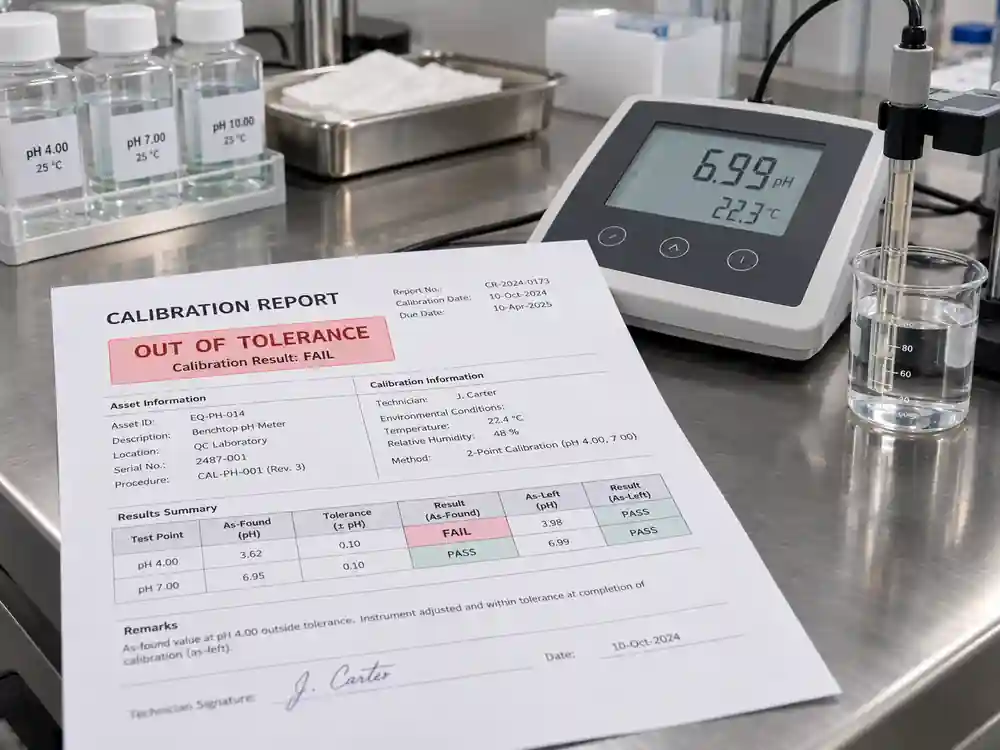
During calibration it is typical to record “As Found” data that reflects the condition of the unit under test (UUT) prior to any adjustment. If there is an adjustment made to the UUT, “As Left” data is recorded to reflect the condition when the calibration was complete.
In some cases, the As Found data will indicate that the UUT did not meet the tolerance assigned during the initial assessment of the UUT. This may be a significant event depending on the criticality of the UUT and how far out of tolerance (OOT) the UUT was determined to be.
When an Out-of-Tolerance Condition May Be Significant
There are two cases where an OOT condition might be particularly significant:
- The UUT is a calibration standard used to verify the accuracy of other equipment.
- The UUT is used to perform measurements that are critical for some other reason, such as product release.
When the OOT Instrument Is a Calibration Standard
If the OOT UUT is a calibration standard, it is possible the OOT condition may be significant enough to affect the integrity of calibrations performed using this UUT as a standard.
A Standard Traceability Report is run to identify any equipment that may have been calibrated using the standard since the last time the standard was calibrated.
Each item that has been calibrated using the OOT standard should be evaluated to determine if the OOT condition of the standard may have adversely affected the calibration performed using that standard.
When the OOT Instrument Is Used for Critical Measurements
If the OOT UUT is used to perform measurements that are critical for any other reason, it is required to identify and contact the owner to alert them, typically with an Out of Tolerance Notification, so an evaluation may be performed.
The owner can evaluate the specifics of the OOT condition to determine if it might have adversely affected data collected since the last successful calibration.
With a properly designed tolerance system, the tolerance is usually such that small excursions would not have a significant effect on the quality of product as a result of the measurement.
Assessing the Potential Impact of an OOT Condition
Some of the specifics to consider in assessing the effect of an OOT condition may include the following:
- Was there some attributable cause for the OOT, such as a gauge that may have been dropped?
- Was the instrument found to be OOT in the measurement range that was used? For example, the UUT is normally used at 100 psi and the reading was found to be OOT at 10 psi.
- Is the tolerance of the UUT so tight compared with the process specification that even with the OOT condition it is still acceptable? For example, the UUT used for measuring room temperature has a tolerance of 0.1 degrees Celsius and was found to be off by 0.2 degrees Celsius, but the room specification is 15 to 30 degrees Celsius.
- Was the OOT in a direction that would not affect the acceptability of the measured result? For example, the overpressure sensor is indicating a value that is too high. This would cause nuisance alarms or shutdowns, but would not allow an alarm condition to go undetected.
- Any additional items particular to the circumstances.
Corrective Actions Following an OOT Investigation
Once the OOT condition has been evaluated and the effect determined, appropriate corrective measures may be taken.
In addition to adjusting or replacing the UUT, the following may be considered:
- Is the UUT the best instrument for the application or environment?
- Is the UUT used as intended by the manufacturer of the UUT?
- Should the calibration be performed more often?
- Should a check system be set up to have the user verify operation of the UUT before each use?
- Is the UUT tolerance appropriate?
- Is the process tolerance appropriate?
- Is the instrument being used and handled correctly?
- Is maintenance being performed?
- What is the overall history of the UUT, similar UUTs, and the calibration provider or standards?
- Are there procedures that could be put in place to reduce the risk?
- Any additional items particular to the circumstances.
Follow-Up and Effectiveness Monitoring
After the OOT and corrective actions have been performed, documented, and approved by quality assurance, ongoing monitoring will, over time, demonstrate whether the corrective actions have been effective. Further information on this and other calibration compliance related issues are discussed in this article.