Every regulated company in the pharmaceutical, biotech, and medical device space generates enormous volumes of data batch records, calibration logs, validation protocols, laboratory test results, maintenance histories, deviation reports, and more. This data is not just operational record-keeping. It is the documentary evidence that your products are safe, effective, and manufactured under controlled conditions. It is what regulators examine during inspections. It is what stands between your company and enforcement action.
Data integrity the assurance that data is complete, consistent, accurate, and trustworthy throughout its lifecycle has become one of the single most cited areas of concern in FDA Warning Letters and EMA regulatory action over the past decade. The regulators’ message is unambiguous: systems and cultures that allow data to be manipulated, deleted, backdated, or selectively reported are unacceptable, and the consequences of failure are severe.
This guide is written for quality, validation, and operations leaders in regulated environments who want to understand data integrity not as a compliance checkbox, but as a fundamental operating discipline. We will cover the ALCOA+ framework in depth, explain what good documentation practice looks like in practice, identify the most common data integrity failures and how they happen, and outline the systems and behaviors that build genuinely trustworthy data environments.
What Is Data Integrity in a GxP Context?
Data integrity in a GxP context refers to the maintenance and assurance of the accuracy, completeness, consistency, and reliability of data over its entire lifecycle from initial creation through processing, review, reporting, storage, and eventual destruction or archival.
The concept applies equally to paper records and electronic systems. A handwritten calibration log and an electronic audit trail in a validated CMMS are both subject to data integrity requirements. The specific technical controls differ, but the underlying expectation is identical: the record must accurately reflect what actually happened, when it happened, and who did it and it must be impossible or at least immediately detectable if anyone attempts to alter that record after the fact.
FDA’s guidance on data integrity, most comprehensively articulated in its 2018 guidance document “Data Integrity and Compliance With Drug CGMP,” makes clear that data integrity principles apply to all data used to make quality decisions or submitted to regulatory authorities. The European Medicines Agency (EMA) and the Medicines and Healthcare products Regulatory Agency (MHRA) have published parallel guidance documents that establish essentially the same expectations under EU GMP frameworks.
What makes data integrity violations particularly dangerous is that they are often discovered during inspections through indirect evidence audit trail gaps, metadata inconsistencies, statistical anomalies in test results, or simply behavioral patterns that suggest records were created after the fact. When regulators find evidence of data integrity failures, the response is rarely limited to the specific records involved. It triggers a systemic review of the entire quality operation and creates fundamental doubt about the reliability of all data the company has ever generated.
The ALCOA+ Framework Explained
The ALCOA+ framework is the internationally recognized standard for evaluating the quality and integrity of GxP data. Originally developed by FDA in the 1990s and subsequently expanded to ALCOA+, the framework provides a practical vocabulary and set of criteria that apply to every record in a regulated environment.
ALCOA: The Original Five Principles
Attributable
Every data entry, observation, or action must be attributable to the specific individual who performed it. In a paper system, this means a legible, dated signature or initials on every record. In an electronic system, it means individual user accounts with unique login credentials shared accounts are categorically non-compliant because attribution becomes impossible. If a calibration result was recorded, a maintenance task was completed, or a process deviation was entered, there must be unambiguous, verifiable evidence of exactly who did it.
Legible
Records must be readable throughout their required retention period. For paper records, this means using permanent ink, writing clearly, and storing documents in conditions that prevent degradation. For electronic records, it means ensuring that data remains accessible in a human-readable format even as software systems are upgraded or replaced, and that printouts or exports from electronic systems accurately represent the underlying data.
Contemporaneous
Data must be recorded at the time the activity occurs not reconstructed from memory afterward, not filled in during a batch review, and certainly not pre-populated before the work is done. Contemporaneous recording is the principle most frequently violated in practice, often not out of malicious intent but simply because documentation systems are inconvenient or disconnected from the actual work being performed. When records are created hours or days after the fact, the accuracy of the recorded data becomes fundamentally suspect.
Original
The original record or a certified true copy must be retained. Original records are the first capture of data as it was generated. Transcribing data from a rough notebook into a formal record, and then discarding the notebook, eliminates the original and creates data integrity risk. Where electronic systems are used, the raw data file not just a summary export must be retained and accessible.
Accurate
Records must truthfully reflect the activity or result they document. Accuracy in a GxP context means more than numerical precision it means that the record as a whole gives a complete and honest picture of what occurred. An accurate record of a deviation documents the actual deviation, not a sanitized version that omits inconvenient details. An accurate calibration record documents the actual as-found condition, not a corrected reading.
The “+” Extensions
The “+” additions to ALCOA reflect evolving regulatory expectations and technological realities:
Complete
All data, including any data that does not support the expected result, must be retained. Selective data retention keeping only passing results and discarding failing ones is one of the most serious forms of data integrity failure. Completeness applies to entire datasets: all runs of a validation protocol, all calibration measurements including those taken before adjustment, all stability data points including early-time-point results.
Consistent
Data and records should be internally consistent and consistent with related records. Timestamps should be logical a step cannot be completed before it was started, and a review cannot precede the activity being reviewed. Equipment used in a recorded activity should match calibration records for that equipment. Personnel documented as performing a task should have training records demonstrating they were qualified to do it.
Enduring
Records must be maintained for their full required retention period, in a format and condition that allows retrieval and review throughout that period. Retention periods in pharmaceutical manufacturing can be 15 years or longer. Paper records must be stored appropriately. Electronic records must be maintained in systems that remain accessible even after software upgrades or vendor changes.
Available
Records must be available for review and inspection when required. This means both physical availability records stored in accessible locations and practical retrievability records that can be found and produced within a reasonable timeframe during an inspection. A record that exists but takes days to locate provides limited assurance to an inspector and reflects poorly on the quality system.
The Most Common Data Integrity Failures And Why They Happen
Understanding where data integrity failures most commonly occur is essential to preventing them. The vast majority of data integrity violations observed in FDA inspections and Warning Letters fall into a small number of recurring patterns.
Backdating and Pre-dating Records
Backdating recording an activity with a date earlier than when it was actually performed is one of the most commonly cited data integrity violations. It occurs when personnel complete an activity and then assign a date that suggests it was done earlier, often to avoid the appearance of a delay or missed deadline. Pre-dating completing paperwork before the work is done is equally problematic and often easier to detect through audit trails and cross-referencing with other records.
Audit Trail Manipulation or Disabling
In electronic systems, FDA investigators routinely check whether audit trail functionality is enabled, whether it captures all required events, and whether it has been tampered with. Companies that disable audit trails for convenience, fail to configure audit trails correctly at system deployment, or allow audit trail data to be overwritten without archival are in direct violation of 21 CFR Part 11 requirements.
Selective Data Deletion
Deleting failing results, out-of-specification readings, or anomalous data points while retaining only favorable results represents one of the most serious forms of data manipulation. This behavior is particularly common in laboratory environments where pressure to produce passing results is high and oversight of raw data files is limited. Electronic systems that retain complete raw data files make this type of manipulation detectable.
Shared User Accounts
When multiple individuals share a single login credential for any GxP-relevant system, attribution becomes impossible. Shared accounts are a categorical violation of 21 CFR Part 11 and are consistently cited in Warning Letters. The root cause is almost always convenience setting up individual accounts requires administrative effort but the compliance risk is enormous.
Transcription Errors and Informal Records
When data is first captured informally on sticky notes, in personal notebooks, on whiteboard logs and then transcribed into official records, the transcription step creates multiple risks: the original capture may be discarded, transcription errors may occur, and the timing of the original capture versus the official record becomes unclear. Contemporaneous recording in the official system eliminates this risk entirely.
Pressure Culture
Perhaps the most insidious data integrity risk is a quality culture in which personnel feel implicit or explicit pressure to produce favorable results, meet timelines at the expense of proper documentation, or avoid escalating problems that might cause delays. When the culture of an organization sends signals however subtly that documentation problems should be “handled” rather than properly corrected, data integrity failures become structurally inevitable.
Documentation Best Practices in GxP Environments
Good documentation practice (GDP) is the day-to-day operational discipline that gives ALCOA+ principles practical form. GDP applies to every person who creates, reviews, approves, or manages records in a regulated environment.
Paper Records: Core GDP Requirements
- Use permanent, indelible ink never pencil
- Corrections must be made with a single line through the error, initialed and dated by the person making the correction, with the correct entry written next to it never use correction fluid (whiteout) under any circumstances
- All entries must be dated at the time of the activity, not reconstructed afterward
- Blank fields must be marked as N/A or filled empty fields are ambiguous and create audit risk
- Signatures and initials must be legible and consistently formed initials used in records should be documented in a reference file that links them to specific individuals
Electronic Records: Core GDP Requirements
- Each user must have an individual, unique login credential no shared accounts
- Passwords must meet complexity requirements and be changed at defined intervals
- Electronic signatures must be linked to the associated record and cannot be transferred or repurposed
- Audit trails must be enabled, configured to capture all required events (creation, modification, deletion, access), and reviewed as part of routine record review
- System clocks must be synchronized and accurate timestamp integrity is fundamental to electronic record credibility
For both paper and electronic systems:
- Records must be reviewed for completeness at the time of completion, not weeks later
- Any unexplained gaps in sequences, timelines, or numbering schemes should be investigated
- Original data must be retained summaries and reports do not replace raw data
- Record retention procedures must be documented and followed consistently
Electronic Records and 21 CFR Part 11
For any company operating regulated systems with electronic records, 21 CFR Part 11 is the governing regulation. Part 11 establishes the technical and procedural requirements that make electronic records equivalent to paper records in terms of regulatory acceptability. It is not optional for systems that generate, store, or transmit regulated electronic records it is a compliance requirement.
The core technical requirements of 21 CFR Part 11 include:
- Closed systems with access controls restricting record access to authorized individuals
- Audit trails that capture date- and time-stamped records of all operator actions and are computer-generated, not manually created
- Electronic signatures that are unique to one individual, cannot be reused or transferred, and include the printed name, date/time, and meaning of the signature
- System validation demonstrating that the system consistently performs as intended
- Record protection preventing unauthorized alteration, obscuring, or deletion
For growing regulated companies, one of the most practical decisions you can make to support 21 CFR Part 11 compliance is deploying systems that are designed from the ground up for regulated environments, rather than configuring general-purpose tools to approximate compliance. 21 CFR Part 11 maintenance software built specifically for GxP environments arrives with audit trail functionality, individual user account management, and role-based access controls already in place eliminating the configuration burden and validation overhead associated with adapting non-compliant tools.
Similarly, 21 CFR Part 11 validation tracking software ensures that the documentation generated by your validation activities IQ/OQ protocols, execution records, reports, change control is itself maintained in a compliant electronic record environment with full audit trail integrity.
Data Integrity in Equipment Management and Calibration
Equipment-related data is among the most scrutinized categories of GxP records during FDA inspections. Calibration records, maintenance logs, out-of-tolerance investigations, and equipment qualification documentation all fall squarely within the scope of data integrity expectations.
The data integrity requirements in equipment management are straightforward in principle but operationally demanding:
- Calibration records must document the actual as-found condition of instruments, not just the post-adjustment final reading. If an instrument was found out of tolerance, that finding must be documented and investigated not quietly corrected and recorded only as “within tolerance after adjustment.”
- Calibration due dates must be tracked and enforced in real time equipment used beyond its calibration expiry represents both a compliance failure and a potential product quality impact
- Maintenance records must document what was done, when, by whom, and what was found including any anomalies or deficiencies identified
- Equipment history files must be complete and current, providing a full chronological record of qualification, calibration, maintenance, and any corrective actions
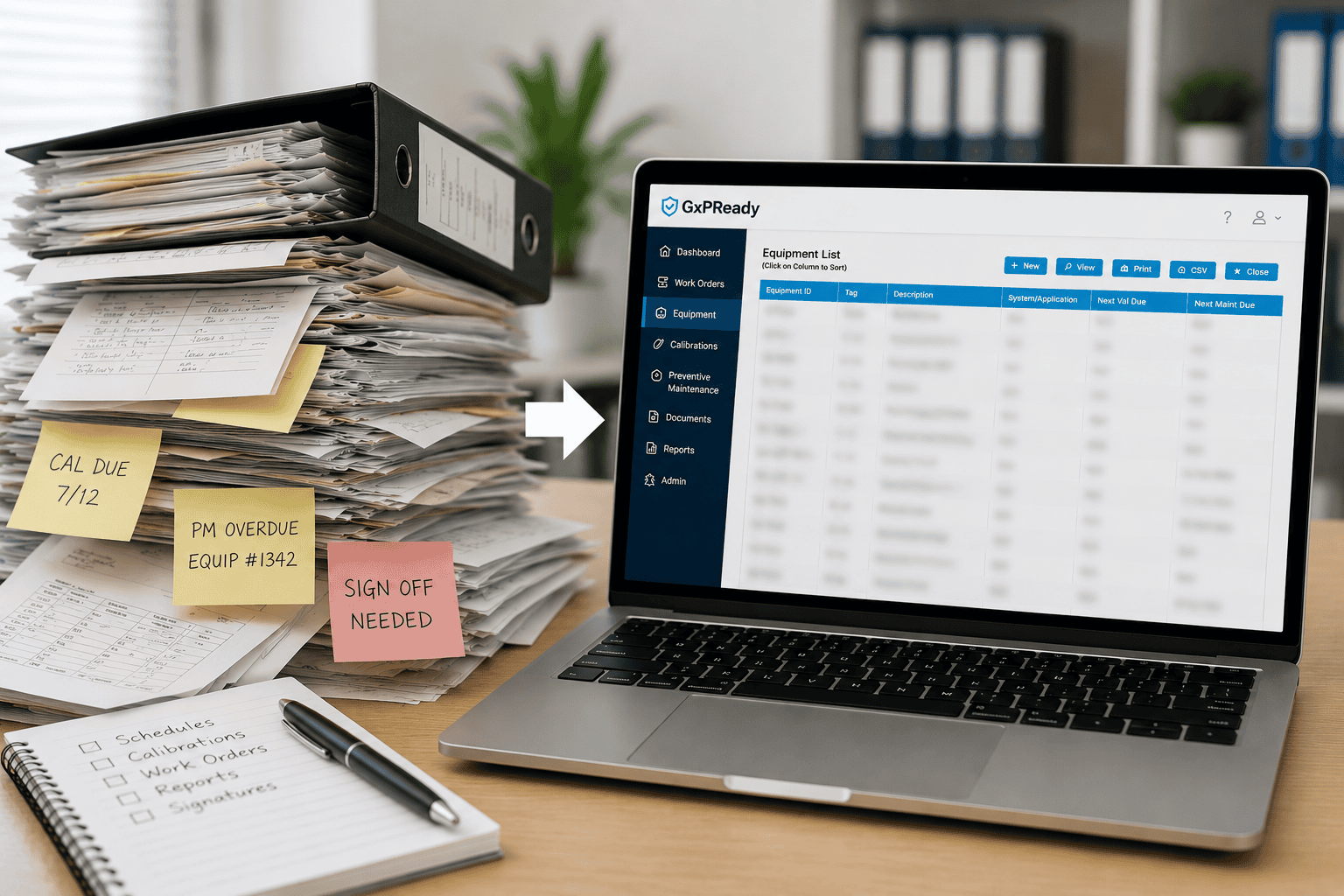
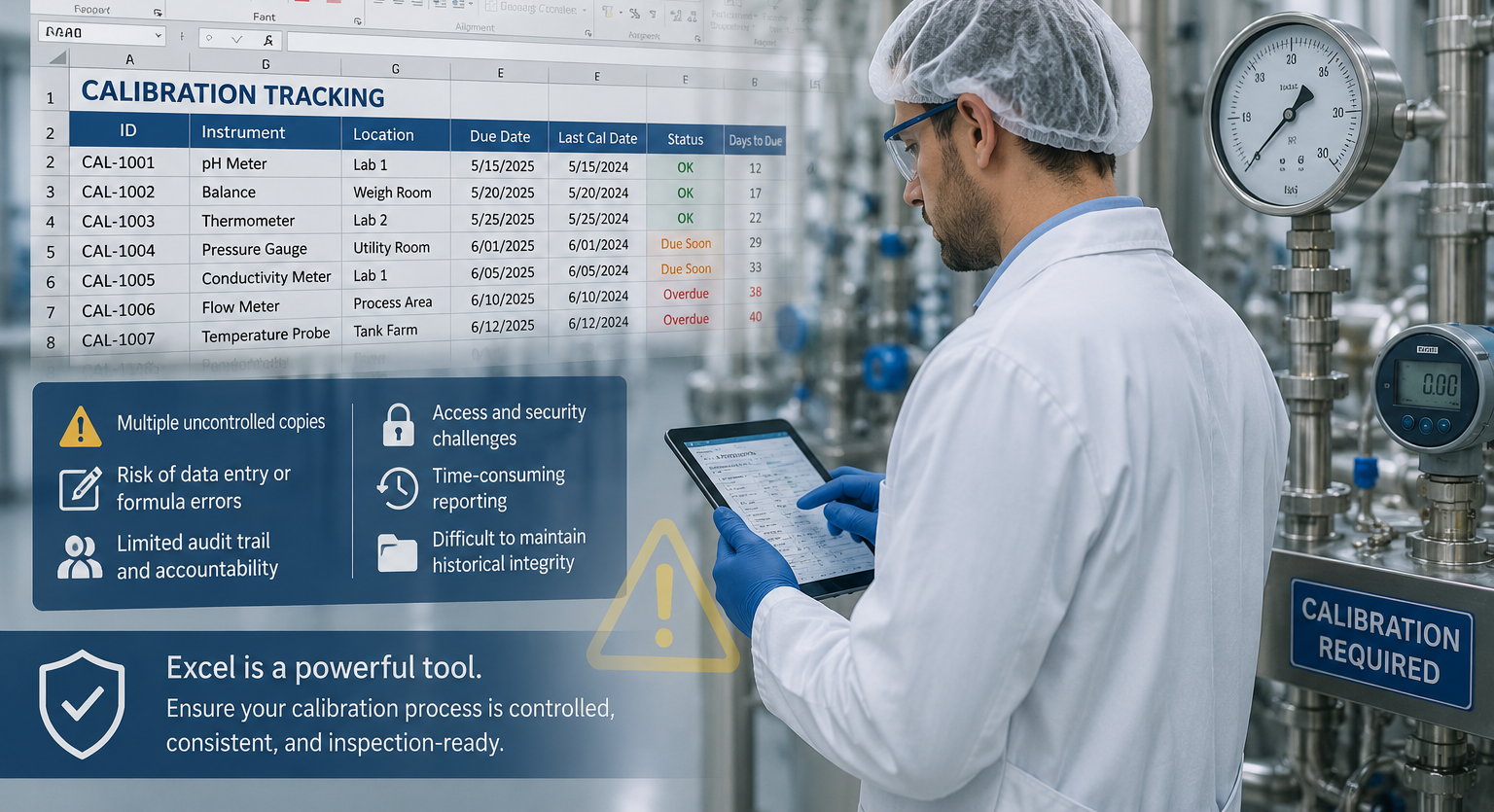
Managing this volume of equipment data manually through spreadsheets, paper logs, or disconnected systems creates inherent data integrity risk. Records are created in different formats by different people, stored in different locations, and retrieved with inconsistent completeness. The result is a data environment that is difficult to audit and easy to question.
Purpose-built GxP calibration software centralizes equipment data in a single validated system, automates calibration scheduling and overdue notifications, and maintains a complete, tamper-evident history for every piece of equipment. When an FDA investigator asks for the calibration history of a specific instrument including any out-of-tolerance findings and associated investigations the answer is available in seconds, complete and unambiguous.
Data Integrity in Validation Documentation
Validation documentation is another area where data integrity failures can have severe consequences. Validation records are the evidence that your processes, systems, and equipment perform as intended. If that evidence is incomplete, inconsistent, or of questionable integrity, the validity of every decision made based on that evidence is called into question.
Common data integrity issues in validation documentation include:
- Retrospective protocol writing creating protocols after execution has already begun or completed, then presenting them as pre-approved documents
- Selective execution reporting documenting only successful protocol executions and omitting failed attempts or deviations encountered during execution
- Undocumented retest justifications retesting out-of-specification results without a documented investigation and rationale
- Change control gaps making changes to validated systems without documenting those changes or assessing their impact on the validated state
Validation tracking software provides the structural controls that prevent these failures. Protocol approval workflows enforce pre-execution sign-off. Execution records capture deviations in real time. Change control modules ensure that post-validation changes are documented, assessed, and appropriately managed. The entire validation lifecycle is traceable, from initial user requirements through ongoing change management.
Data Integrity Across the Full Equipment Lifecycle
Data integrity is not a single-point requirement it applies continuously across the full lifecycle of equipment and systems in a regulated environment. From initial procurement and qualification through routine operation, periodic maintenance, calibration, deviation handling, and eventual decommissioning, every phase generates records that must meet ALCOA+ standards.
A validated CMMS provides the infrastructure to manage this full lifecycle in a compliant, integrated way. Rather than managing different phases of equipment lifecycle in disconnected systems qualification in a shared drive, calibration in a spreadsheet, maintenance in a work order system a validated CMMS brings everything together in a single validated environment. This integration eliminates the transcription risks and data consistency problems that arise from managing the same equipment record across multiple disconnected tools.
The GxPReady platform is specifically designed for this purpose: a centralized, validated environment where calibration records, maintenance histories, qualification documentation, and equipment registries coexist within a single 21 CFR Part 11-compliant system. Independent database environments ensure data isolation between customers. Pre-built audit trails ensure that every action taken on every record is captured automatically, without relying on user discipline to maintain integrity.
Building a Data Integrity Culture
Technology is necessary but not sufficient for data integrity. Systems provide the controls but culture determines whether people work within those controls honestly or attempt to circumvent them.
A genuine data integrity culture has several characteristics that distinguish it from a compliance-on-paper organization:
Leadership sets the tone visibly and consistently. When quality leadership communicates clearly that complete and accurate documentation is more important than schedule pressure, and backs that message with actual decisions including willingness to delay a batch release or escalate a deviation rather than paper over it personnel at every level receive the right signal.
Deviations are treated as opportunities, not failures. In organizations with strong data integrity cultures, identifying and documenting a problem is understood as the correct behavior, not evidence of individual failure. When people fear that raising issues will result in blame rather than problem-solving, they become motivated to avoid documentation which is precisely the wrong outcome.
Documentation systems are designed to make compliance easy. A significant contributor to data integrity failures is documentation systems that are inconvenient to use in real time. When it is easier to jot something down on a scrap of paper and transcribe it later than to document it correctly in the official system, transcription-based integrity failures are predictable. System design should minimize friction for contemporaneous documentation.
Data integrity training goes beyond procedures. Effective data integrity training explains not just what the requirements are, but why they exist including the real-world consequences of failures for patients, for the company, and for the individuals involved. Personnel who understand why data integrity matters are more likely to maintain it under pressure than those who only know the procedural rules.
Routine self-inspection catches issues before regulators do. Regular internal audits specifically focused on data integrity reviewing audit trails, checking for record completeness, verifying the consistency of related records catch emerging issues before they become significant findings. Many companies audit procedures; fewer audit the quality of their data documentation itself.
What Regulators Look for During Data Integrity Inspections
When FDA or EMA investigators arrive with data integrity as an area of focus, their approach is systematic and increasingly sophisticated. Modern investigators are trained to look beyond surface-level record review and examine the metadata the data about the data that reveals the true history of a record.
Specific investigator techniques include:
- Reviewing electronic audit trails for gaps, unusual patterns, or evidence of repeated deletions and re-entries
- Comparing electronic record timestamps with metadata embedded in files to identify backdating
- Looking for statistical anomalies in laboratory data results that cluster suspiciously close to specification limits, or datasets with implausibly low variability
- Requesting raw data files and comparing them to summary reports or formal records
- Cross-referencing records from multiple systems calibration records, batch records, training records to identify inconsistencies
- Interviewing personnel at different levels of the organization to assess whether the compliance culture is genuine or cosmetic
- Asking for records in their native format, including audit trail exports, rather than accepting printed summaries
Key documents and systems investigators commonly request:
- Complete audit trail exports from all GxP-relevant electronic systems
- System access logs and user account records
- Training records for all personnel involved in record creation and review
- Backup and archival records to verify completeness of retention
- Computer system validation documentation for all electronic record systems
- Deviation and CAPA records related to any previously identified data integrity concerns
Corrective Actions When Data Integrity Failures Are Found
When a data integrity failure is identified whether through internal audit, self-inspection, or regulatory observation the response must be systematic, thorough, and documented.
A credible data integrity CAPA includes several components that regulators look for:
Immediate containment: Identify and quarantine affected records. Assess the impact on any product, process, or decision that relied on the affected data. If product quality decisions were made based on compromised data, a formal product quality review is required.
Root cause investigation: Determine why the data integrity failure occurred. Was it a system design failure that made manipulation easy? A training deficiency? Deliberate falsification? The root cause drives the corrective action a technological fix will not prevent recurrence if the root cause was a pressure culture, and a training intervention will not prevent recurrence if the root cause was inadequate system controls.
Systemic assessment: Determine whether the identified failure is isolated or indicative of a broader pattern. FDA has made clear in multiple Warning Letters that discovering a data integrity problem in one area creates an obligation to assess the integrity of data across the entire quality system. A narrow response to a broad problem is itself a compliance failure.
Preventive controls: Implement the technical and procedural controls that will prevent recurrence whether that means deploying validated electronic systems with proper audit trails, eliminating shared accounts, implementing a data integrity self-inspection program, or addressing the cultural factors that contributed to the failure.
Verification of effectiveness: Document how you will confirm that the corrective actions were implemented correctly and are working as intended. Effectiveness verification is a required component of any CAPA and is specifically examined by investigators during follow-up inspections.
Practical Steps to Strengthen Your Data Integrity Program Today
For quality and operations leaders who want to assess and improve their current data integrity posture, the following practical steps provide a useful starting framework:
Assess your current systems:
- Identify every system used to generate, manage, or store GxP-regulated data
- Determine which systems are validated and which are not
- Confirm that all electronic systems have audit trail functionality enabled and correctly configured
- Eliminate shared user accounts across all GxP-relevant systems
Assess your documentation practices:
- Conduct a documentation review across recent batch records, calibration logs, and deviation reports looking for completeness, contemporaneity, and consistency
- Check whether raw data is retained alongside summary records
- Verify that corrections in paper records are made correctly and that no whiteout or equivalent alterations exist
Assess your culture:
- Conduct anonymous surveys or interviews with quality and operations personnel about how documentation pressure is experienced in practice
- Review recent CAPA records are deviations reaching root cause, or is there a pattern of superficial investigation?
- Confirm that training programs address the why of data integrity, not just the what
Implement structural controls:
- Deploy validated electronic systems that build compliance into the workflow rather than depending on individual discipline
- Establish a data integrity self-inspection program as part of your internal audit schedule
- Create a formal data integrity policy and ensure it is communicated and trained at all levels
Conclusion: Data Integrity Is Not a Compliance Project It Is How You Operate
The regulated industries exist to produce products that are safe and effective for patients. The entire regulatory framework GMP requirements, validation obligations, inspection programs exists to give regulators and the public confidence that what is on the label is what is in the product, made under conditions that consistently deliver quality. Data integrity is the thread that connects every element of that framework.
When data integrity fails, it does not just create a compliance finding. It undermines the fundamental reliability of every quality decision the organization has made. That is why regulators treat data integrity failures with the severity they do and why growing regulated companies cannot afford to treat it as anything less than foundational.
The good news is that building a genuine data integrity program is not technically complex. It requires clear policies, appropriate systems, consistent training, and the cultural commitment to document what actually happened every time, without exception. For companies seeking the right infrastructure foundation, explore the GxPReady platform or contact the team to discuss how validated, 21 CFR Part 11-compliant systems can support your data integrity program from day one.
If you have questions about specific GxP compliance requirements or how GxPReady supports regulated operations, the frequently asked questions page covers the most common topics in depth.
FAQs
1. What does ALCOA+ stand for in GxP?
ALCOA+ stands for Attributable, Legible, Contemporaneous, Original, Accurate, plus Complete, Consistent, Enduring, and Available. These are the nine principles that ensure data integrity in regulated environments.
2. Why can’t I use shared login accounts in a GxP system?
Shared accounts make it impossible to attribute actions to a specific person, which violates the “Attributable” principle of ALCOA+ and is a direct violation of 21 CFR Part 11.
3. Can I use whiteout to correct an error on a paper GxP record?
No. Whiteout is never permitted. You must draw a single line through the error, initial and date it, and write the correct entry next to it.
4. What is the most common data integrity violation found by FDA?
Backdating or pre-dating records, followed closely by audit trail manipulation and selective deletion of failing results.
5. How does software help with 21 CFR Part 11 compliance?
Purpose-built GxP software provides built-in audit trails, individual user accounts, role-based access controls, and system validation documentation—eliminating manual compliance work.